

The modern luxury home can already do remarkable things.
Lighting can adjust automatically throughout the day. Climate systems can respond by room and occupancy. Shades can move with changing sunlight. Security, entertainment, access control, energy management and other functions can operate quietly in the background.
The best of these systems are increasingly invisible. The technology disappears into the architecture while the residence becomes more responsive to the people who live within it.
But another evolution is beginning.
Instead of asking only what the home can do, engineers, building scientists and technology researchers are increasingly asking what a building can know about itself.
Is an air conditioning system beginning to perform differently than it did a year ago?
Has moisture developed somewhere it should not be?
Is water flowing when the residence is supposed to be inactive?
Has the electrical demand of a pump gradually changed?
Did the building envelope behave differently after a severe storm?
Is one part of the residence experiencing environmental conditions that are inconsistent with the rest of the home?
And could information from several systems eventually be considered together rather than presented as a collection of unrelated alerts?
This is where digital twins, increasingly sophisticated sensors, building analytics and artificial intelligence begin to move the conversation beyond the traditional smart home.
Commercial buildings are already moving in this direction. The more interesting question for residential construction is how much of this intelligence makes sense for an exceptional custom home, what is realistically available today and what homeowners building now should consider preparing for in the future.
The distinction matters because the terminology can easily become blurred.
A smart home is primarily designed around control, automation and the occupant experience.
It knows that the homeowner wants the shades lowered.
It can maintain a desired temperature.
It can activate a lighting scene.
It can secure doors, manage entertainment, coordinate energy use or prepare the residence for arrival.
Building intelligence is concerned with something different: the physical residence and the relationships among its components.
Consider something as ordinary as a thermostat.
A smart home platform may know the current temperature, the desired temperature and whether the homeowner wants the room warmer or cooler.
A more complete digital building model could potentially know which air handler serves that room, which ducts deliver the air, what equipment is installed, when it was commissioned, which other spaces share the system, where important components are located and how the equipment has historically performed.
Connect that information to operating data and the questions become more useful.
Is the system running longer than it normally does under similar outdoor conditions?
Has supply air temperature changed?
Has humidity increased?
Has airflow declined?
Has electrical consumption changed?
They are not competing ideas. The most sophisticated residences may ultimately use both.
Ronin has previously explored the evolution of invisible smart home technology and the importance of integrating technology into the architecture from the beginning. The next step is understanding how some of that same infrastructure may allow the physical residence itself to become more observable.
Some technologies that appear futuristic in residential construction are already being developed and deployed in commercial buildings.
Modern Building Automation and Control Systems can supervise heating, ventilation and air conditioning, lighting, access control, energy systems and other building operations. More sophisticated platforms incorporate fault detection and diagnostics that analyze operating information for unusual conditions rather than waiting for complete equipment failure.
The U.S. Department of Energy continues to support research involving advanced building controls, automated fault detection and increasingly sophisticated corrective control.
The National Institute of Standards and Technology is exploring another layer through its work in building digitization and semantic interoperability.
NIST’s research contemplates digital twin frameworks capable of connecting information from design, construction and building operations in machine readable form. The objective is not simply to collect more data. It is to establish relationships among that information so advanced analytics, automation and artificial intelligence can make greater use of it.
That distinction is important.
A temperature sensor knows a temperature.
A control system knows whether a valve is open.
An equipment record knows which air handler was installed.
A digital building model may know where the mechanical room is.
A maintenance record knows when equipment was last serviced.
The digital twin concept attempts to connect those pieces so the system can understand not merely individual data points, but their relationships. That is where the concept becomes particularly interesting for a complex luxury residence.
Long before artificial intelligence enters the discussion, there is a much simpler opportunity.
Document the house properly.
One of the paradoxes of exceptional residential construction is that some of the most important work eventually disappears.
Behind finished walls and ceilings may be structural connections, plumbing, electrical conduit, ductwork, control wiring, drainage lines, waterproofing transitions, blocking, low voltage infrastructure and other components that may not be seen again for decades.
As Ronin has emphasized in its examination of the workmanship behind finished surfaces, concealed systems can have an enormous influence on how the residence ultimately performs.
Digital building technology raises another question:
Once those systems disappear behind the finishes, does all of that information need to disappear with them?
Increasingly, the answer is no.
Reality capture, laser scanning, detailed construction photography and Building Information Modeling can preserve substantially more information about what was actually constructed.
That is different from an architectural drawing.
Plans describe what was designed.
A carefully maintained digital as built record can help document what was actually installed.
For a major custom residence, that could eventually mean knowing where plumbing is located before opening an expensive stone wall, identifying structural backing before installing significant artwork, locating concealed infrastructure before adding new technology or giving a future architect a far more complete understanding of the home before a renovation begins.
Equipment information can also become part of the record, including model information, installation dates, warranties, technical documentation, associated rooms or zones and maintenance history.
The National Institute of Building Sciences has identified the integration of BIM and digital twin technology as an important opportunity for carrying building information from design and construction into long term operations.
For luxury residential construction, this may be one of the most practical ideas in the entire digital twin discussion. It does not require a house that thinks. It requires a house whose history has not been lost.
A homeowner does not need to wait for a fully developed residential digital twin to benefit from better building information.
Several useful technologies already exist.
Whole home flow monitoring systems can observe water consumption and identify patterns associated with unusual use or potential leaks. Depending upon the system and installation, they may alert the homeowner and can sometimes shut off the water supply automatically.
The EPA now provides residential guidance addressing both moisture based leak detectors and whole home flow monitoring technologies.
On their own, those systems are already useful.
Connected to better information about the building, however, an alert can become more meaningful.
Instead of simply reporting:
Unusual water flow detected.
A future building intelligence platform could help place the event within the physical context of the residence.
Which plumbing systems are nearby?
What equipment was operating?
Have local moisture readings changed?
Did the condition begin shortly after a particular appliance or fixture was used?
The digital model does not magically diagnose the leak. It provides context for investigating it. That difference is fundamental to understanding responsible building intelligence.
Temperature and humidity have been monitored in homes for decades.
Modern environmental monitoring can go considerably further, measuring combinations of particulate matter, carbon dioxide, selected volatile organic compounds and other indoor conditions.
For a South Florida residence, humidity deserves particular attention.
A humidity reading by itself tells us something.
Humidity considered alongside HVAC runtime, outdoor conditions, occupancy, condensate behavior and moisture readings may tell us considerably more.
Perhaps one area of the home is recovering from elevated humidity more slowly than it historically did.
Perhaps a mechanical zone is operating longer while accomplishing less.
Perhaps environmental conditions near an exterior assembly have begun behaving differently from the rest of the residence.
The objective is not to fill the homeowner’s phone with more numbers. It is to understand whether the indoor environment is behaving as expected.
Commercial buildings increasingly use automated fault detection and diagnostic systems to identify abnormal operation within HVAC and building control systems.
The same principle is beginning to have relevance to sophisticated residential mechanical systems.
Suppose an air conditioning zone begins taking progressively longer to reach its normal temperature.
Nothing has failed.
There may be no alarm.
But something has changed.
Perhaps airflow has declined.
Perhaps equipment performance has deteriorated.
Perhaps a control is not operating correctly.
Perhaps occupancy or weather conditions explain the change and nothing important is wrong.
The value of monitoring is not that software instantly knows the answer.
The value is that a change may become visible earlier. This is one of the most credible uses of building analytics: establishing how a system normally behaves and identifying meaningful departures from that pattern.
A home containing dozens of connected systems could easily become overwhelmed by information.
That would be a failure of design.
A homeowner should not need to monitor duct pressure, motor current, humidity trends, electrical demand, equipment runtimes and water flow graphs simply because those measurements exist.
The most successful interface might be remarkably simple.
Safety — Normal
Indoor Environment — Healthy
Water — Normal
Electrical — Normal
Mechanical Systems — Normal
Building Envelope — Normal
Backup Power — Ready
Maintenance — Two Items
The complexity exists underneath.
A property manager, service technician, mechanical contractor or engineer can access deeper diagnostic information when it is needed.
The homeowner receives what matters.
That may ultimately become one of the best definitions of residential technology at the highest level: sophistication without burden.
In selected circumstances, it can provide clues.
But this is also an area where technology can easily be overstated.
There is no universal sensor capable of detecting every developing problem concealed within a structure.
Different failures create different signals.
A plumbing leak may create moisture.
An envelope failure may change moisture levels or air movement.
A mechanical problem may alter temperature, airflow or electrical demand.
An electrical connection may generate abnormal heat.
Structural movement requires entirely different forms of measurement.
The opportunity therefore comes from targeted sensing.
Researchers have explored moisture sensing within building assemblies, while modern monitoring systems can watch selected locations where concealed water could have particularly serious consequences.
For a major South Florida residence, this could make sense around certain complex glazing conditions, roof transitions, parapets, terraces, mechanical spaces or other assemblies where early warning may help prevent substantial damage.
The objective should not be to place sensors everywhere simply because it is technically possible.
Where would an unnoticed failure matter enough that early information could change the outcome?
This question illustrates both the potential and the limitations of the technology.
A house cannot presently identify every failing window simply by monitoring pressure.
Pressure measurement can, however, provide useful information about how a building envelope is behaving.
Research at Lawrence Berkeley National Laboratory demonstrated that relatively inexpensive MEMS pressure sensors could be used for continuous pressure measurement and, under the conditions of the study, estimate changes in building envelope air leakage within approximately 3 to 16 percent of standardized testing.
The research was not a demonstration that a luxury residence can automatically identify a failed individual window.
That distinction matters.
But imagine a future residence in which several observations are considered together after a severe storm.
Pressure behavior in one part of the house changes.
Humidity near an exterior wall begins rising.
A local moisture sensor reports an abnormal condition.
Dehumidification demand in that area increases.
None of those measurements alone proves what happened.
Together, they may justify investigation.
A responsible intelligent system might eventually report:
Environmental and pressure conditions along the southeast façade have departed from their normal baseline following the storm. Inspection is recommended.
That is far more credible than a futuristic system announcing that a particular window has failed. Good technology should understand the limits of what it knows.
This possibility has particular relevance in South Florida.
Today, post hurricane evaluation remains predominantly visual and physical.
Qualified professionals inspect roofing, glazing, waterproofing, structural conditions, water intrusion, electrical systems and mechanical equipment.
Building intelligence should not replace that process.
It may eventually give those professionals another category of evidence:
How did the building’s behavior change?
Compare the residence before and after the event.
Did a wall assembly that had historically remained dry develop moisture?
Did pressure relationships change?
Did one HVAC zone develop unusual humidity?
Did a pump or motor experience an abnormal load?
Did backup power equipment perform as expected?
Did electrical demand change in an unexplained way?
The information would not replace a qualified inspection.
It could make that inspection more informed.
The value of an intelligent home is not necessarily that it makes decisions without people. Sometimes its greatest value may be giving knowledgeable people better evidence sooner.
Artificial intelligence introduces another layer.
NIST’s building digitization research specifically contemplates technologies including knowledge graphs, machine learning and large language models as tools that may help organize building information and support more advanced analytics, automation and control.
The most credible near term value of AI may not be a residence that autonomously diagnoses every problem.
It may be a residence that becomes better at answering one deceptively simple question:
Is this normal?
Every functioning building develops patterns.
An air conditioning system has typical runtimes under particular outdoor conditions.
A pump has an expected electrical load.
Indoor humidity follows recognizable behavior.
Water consumption develops patterns.
Rooms respond differently according to occupancy.
Equipment develops operating histories.
Analytics can compare current behavior with those historical baselines.
That is important because developing problems do not always cross an obvious threshold.
An air conditioning system does not necessarily move from healthy to failed overnight.
Performance can slowly deteriorate.
A pump may draw slightly more current over time.
Humidity recovery may gradually take longer.
Equipment may begin operating for more hours to achieve the same result.
Viewed independently, those differences can be subtle.
Viewed historically, they may become meaningful.
But artificial intelligence should not be romanticized.
Sensors fail. Measurements drift. Buildings change. People change how they use rooms. Weather produces unusual conditions. Renovations alter systems. And some failures occur suddenly without useful warning.
The residence should not be thought of as all knowing. A more credible description is better informed.
This may be the most useful question in the entire discussion.
A homeowner designing a major custom residence today does not necessarily need to request a “full digital twin.”
In many cases, that may not even be the right objective.
A better conversation begins with building a foundation for future intelligence.
Preserve the Construction Record
Decide how the residence will be documented before concealed work disappears. Construction photography, reality capture, accurate as built information and organized equipment documentation can provide value long before sophisticated building intelligence is added.
Design Infrastructure That Can Change
Technology evolves much faster than architecture. Accessible conduit, organized low voltage pathways, robust networking, useful equipment spaces, electrical capacity and serviceable controls can make future technology easier to adopt without disturbing expensive finishes.
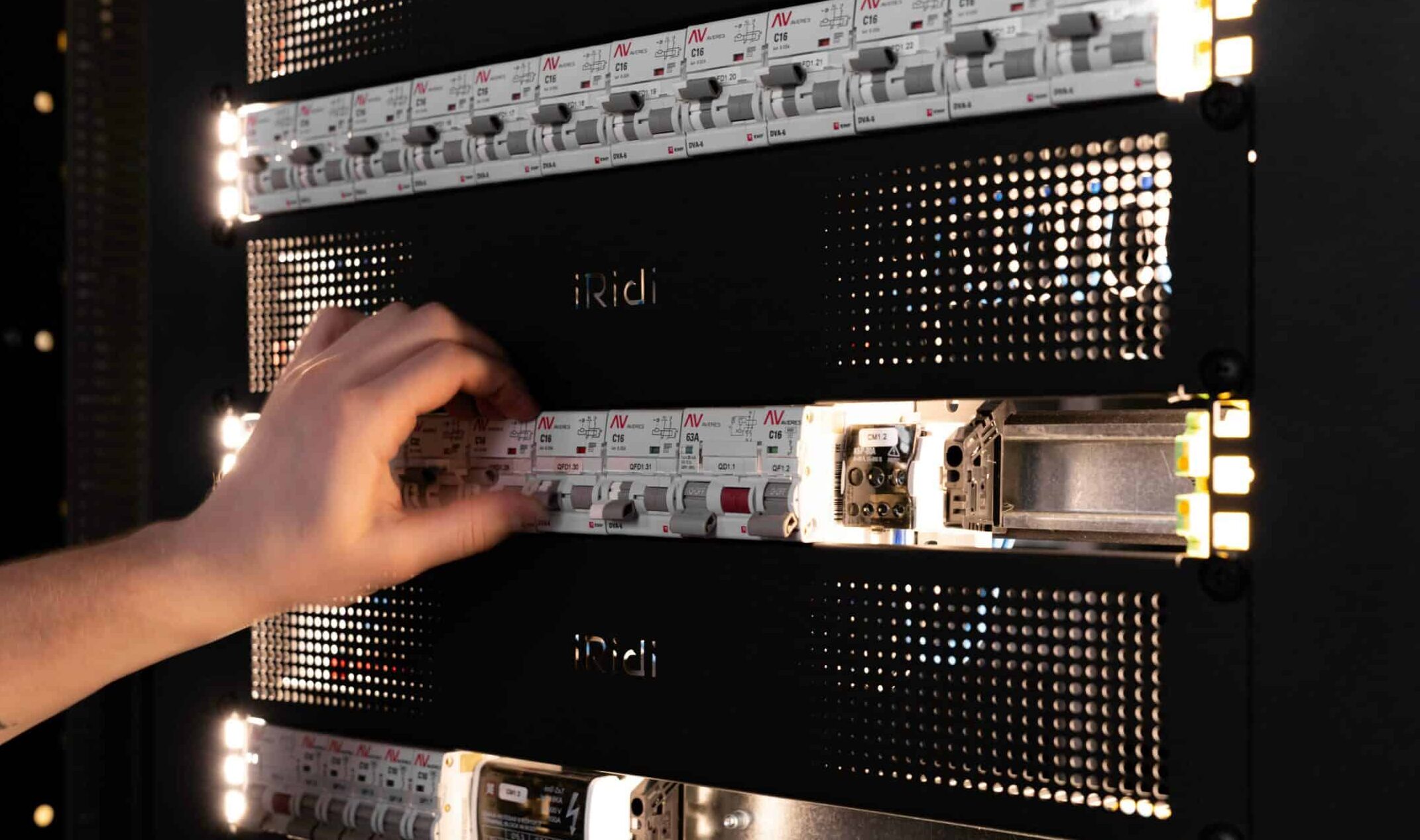
This follows the same principle Ronin has previously explored in its examination of the systems behind the walls: decisions made before concealment can influence how the residence performs for decades.
Monitor What Matters
More sensors are not automatically better. Water, humidity, indoor air conditions, important mechanical equipment and selected vulnerable building assemblies may present meaningful opportunities.
The question should always be:
What decision could we make differently if we had this information?
If there is no useful answer, the measurement may not be worth adding.
Avoid Unnecessary Proprietary Dependence
A luxury residence may last for generations. A software company may not.
Technology should therefore be selected with serviceability, interoperability and future replacement in mind.
Data that can be preserved or exported has value.
Infrastructure capable of accepting future hardware has value.
Critical systems capable of continuing essential operation when outside services are unavailable have value.
The architecture may last a century. The software will not.
Plan for the People Who Will Maintain It
A digital model remains useful only while it continues to represent the physical residence accurately.
Equipment gets replaced. Rooms are renovated. Systems are modified. Sensors require maintenance.
If the digital representation no longer matches the home, confidence in the information deteriorates.
Long term stewardship therefore matters as much as initial installation.
Treat Cybersecurity as Part of the Building
Greater connectivity creates another responsibility.
When technology controls entertainment, a failure is mostly an inconvenience.
When connected systems interact with access control, mechanical equipment, electrical systems, water, security and environmental monitoring, the consequences can be more significant.
NIST’s September 2026 draft Revision 4 of its operational technology security guidance specifically includes Building Automation and Control Systems and emphasizes that systems interacting with physical processes must be considered in terms of reliability and safety as well as conventional information security.
For an advanced residence, cybersecurity planning should therefore be part of the technology conversation from the beginning.
Network architecture, controlled remote access, software maintenance, permissions, protection of critical systems and an understanding of where the residence’s information is stored all become part of responsible design.
Cybersecurity should not be added as an afterthought. It becomes another concealed system protecting the home.
The most interesting future of residential technology may not be a home filled with more automation.
It may be a residence capable of developing a deeper understanding of itself.
The digital record preserves what was built.
Sensors observe selected conditions.
Building systems report how they are operating.
Historical information establishes normal behavior.
Analytics identify meaningful changes.
Artificial intelligence may help connect information that once existed in separate systems.
And qualified professionals remain responsible for interpreting what those changes actually mean.
The result is not a science fiction residence that predicts every failure.
It is something more realistic and potentially more valuable.
A home that retains its construction history.
A home that provides better information about its environment.
A home that makes selected hidden conditions more observable.
A home that may reveal certain changes before they become severe.
And a home that gives future owners, contractors, architects and engineers a deeper understanding of the building they are responsible for protecting.
At Ronin Development, advanced technology begins with the same principle that guides every other part of an exceptional custom residence: technology must serve the architecture, the performance of the building and the people who live within it.
The smartest decision for someone building today may therefore not be installing every emerging technology available.
It may be creating a residence that is ready to become more intelligent over time.
Document it well.
Build the infrastructure properly.
Monitor what truly matters.
Keep critical systems serviceable.
Protect the network.
Preserve flexibility.
Because the future of luxury residential technology may ultimately be less about how many things the home can control and more about how well the home can help us understand what is happening within it.
If you are considering building a luxury custom home in South Florida, Ronin Development welcomes the opportunity to learn about your vision. Through thoughtful planning, disciplined construction, future ready infrastructure and careful integration of advanced building systems, a residence can be designed not only for extraordinary architecture and comfort today, but with the flexibility to accommodate technologies and possibilities still to come.

General resources: Digital twin capabilities, building automation, sensors, fault detection, environmental monitoring, water monitoring, building envelope measurement, BIM, reality capture, artificial intelligence, equipment analytics, cybersecurity, interoperability, data retention, network architecture and other building intelligence technologies should be evaluated using current technical information for the specific systems under consideration. Structural, mechanical, electrical, environmental, cybersecurity, hurricane, building envelope, permitting and code requirements should be confirmed under the conditions and requirements applicable to the particular residence and project.
This article is intended to provide general construction, planning and technology information. Examples involving digital twins, sensors, building analytics, artificial intelligence, automated fault detection, building envelope monitoring and other emerging technologies describe current research, existing commercial applications or potential residential applications and should not be interpreted as a representation that any particular residence can automatically identify, predict or diagnose a specific failure. Monitoring and analytical systems can produce incomplete, inaccurate or false information and do not replace inspection, maintenance, testing, engineering evaluation or other services by appropriately qualified professionals. Any guidance provided by Ronin Development is limited to the services and responsibilities stated in the applicable written agreement. Ronin Development does not provide architectural, structural engineering, mechanical engineering, electrical engineering, cybersecurity consulting, building science engineering, environmental testing, inspection, legal, insurance or other professional services unless a particular service is expressly included in a written agreement and performed by an appropriately licensed or qualified professional. Requirements and performance vary according to the property, jurisdiction, building design, construction assemblies, selected equipment, environmental conditions, network architecture, controls, software, sensors and applicable codes and approvals. Owners should obtain project specific guidance from the appropriate qualified professionals before approving designs, modifying building systems, purchasing technology or relying upon monitoring information for decisions involving the safety, condition or performance of a residence.